From Regional Commitments to Tangible Business Results: EU–WB6 Dialogue Focuses on Implementation
Budva, Montenegro | 1 October 2026
The dialogue between the Western Balkans business community and the European Commission continued in Budva, with a shared focus on how regional integration can translate into more tangible results and opportunities for businesses across the Western Balkans.
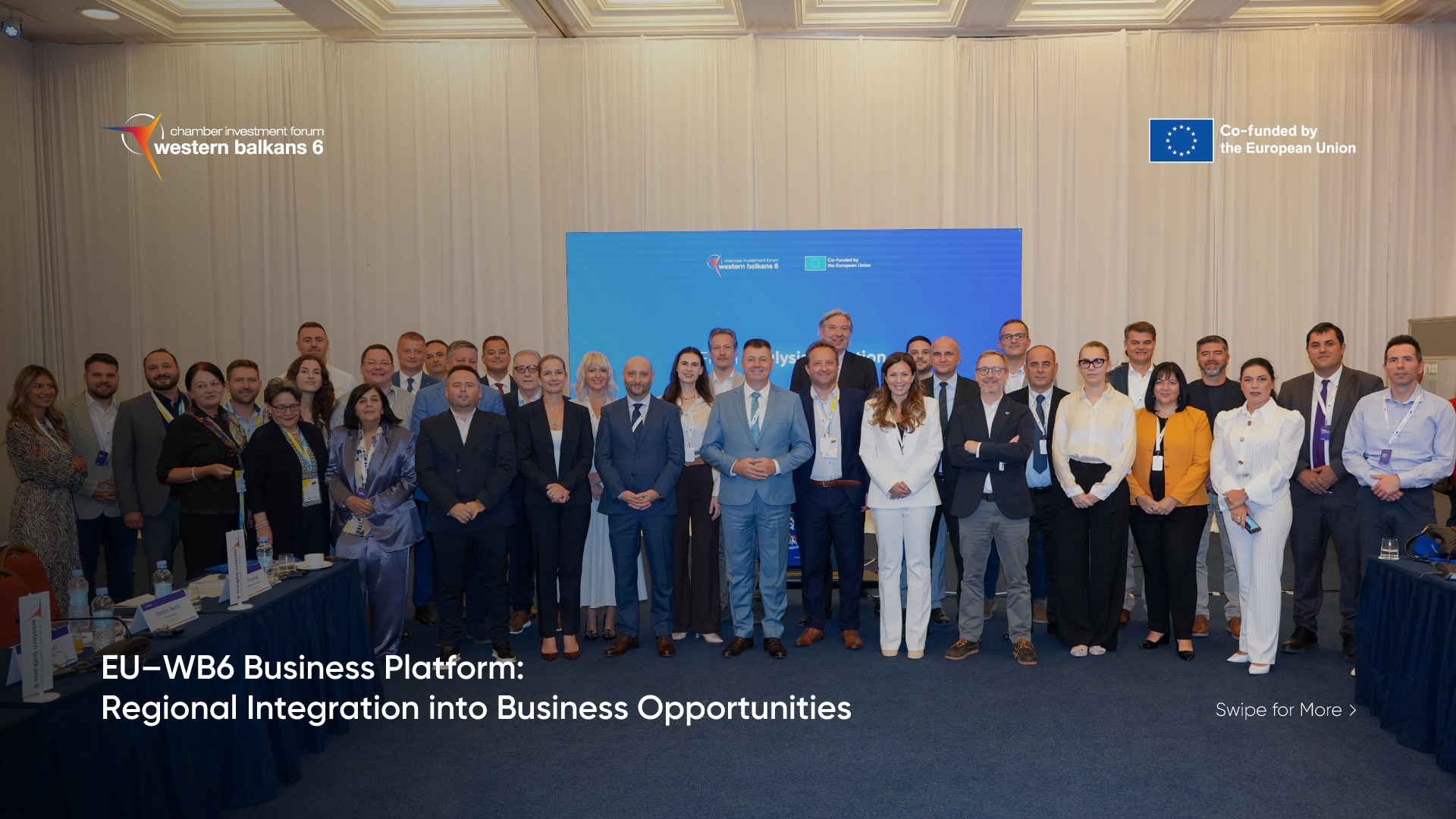
The EU–WB6 Business Platform Meeting, organised under the theme “Where it stands? Western Balkans economies 3 years after the Growth Plan and 2 years after the Common Regional Market Action Plan 2.0,”brought together representatives of the Western Balkan Chambers of Commerce, the WB6 CIF Business Council, governments, the European Commission, CEFTA and other regional stakeholders.
The discussions focused on assessing the progress of the Common Regional Market (CRM) and the EU Growth Plan, while providing an opportunity to address practical challenges affecting trade, investment and business competitiveness across the region.
From Commitments to Implementation
The Common Regional Market and the Growth Plan provide an important framework for strengthening economic integration within the Western Balkans and bringing the region closer to the EU Single Market. The EU Growth Plan combines closer Single Market integration, deeper regional cooperation through the CRM, reforms and increased financial support.
However, discussions in Budva highlighted that the impact of these frameworks ultimately depends on how effectively commitments are implemented in practice.
The WB6 CIF Business Council and business representatives pointed to several challenges that continue to affect day-to-day operations, including long waiting times at borders, rising transport costs, complex customs procedures, infrastructure bottlenecks and administrative requirements.
The Common Regional Market aims to address precisely this type of fragmentation. According to the European Commission, trucks in the Western Balkans spend around 28 million hours waiting at borders every year, representing a significant economic burden for the region.
For companies operating across several markets, even relatively small administrative or logistical obstacles can accumulate into significant costs and delays.
Creating Practical Conditions for Competitiveness
Regulatory alignment is an important part of regional integration, but businesses also need practical conditions that allow them to compete successfully in regional, EU and international markets.
This includes faster and more predictable procedures, access to finance, skilled workers, innovation and technology, adequate infrastructure, and stronger connections with regional and European supply chains.
Participants therefore stressed the importance of moving from the adoption of rules towards ensuring that their implementation delivers measurable benefits for businesses.
This also means creating more effective mechanisms for trusted and compliant companies, improving customs procedures, reducing duplicated documentation and strengthening mutual recognition of standards and certificates.
The EU Growth Plan already identifies free movement of goods, services and workers, road transport facilitation, digital integration, energy decarbonisation and integration into industrial supply chains among its priority areas.
Stronger Support for SMEs and Exporters
Small and medium-sized enterprises were an important part of the discussion, as they can face greater difficulties in absorbing the costs associated with regulatory compliance, certification, market entry and internationalisation.
Participants highlighted the importance of better access to EU funding, targeted support for exporters, innovation programmes and stronger sectoral cooperation.
The Growth Plan’s Reform and Growth Facility provides €6 billion for 2024–2027, including grants and concessional loans linked to the implementation of agreed reforms. The European Commission has already released funds to several Western Balkan economies following assessments of reform progress.
The challenge now is to ensure that available instruments and resources are effectively connected with the needs and opportunities identified by the business community.
Addressing Barriers Through Stronger Dialogue
The meeting also highlighted the importance of closer cooperation between the WB6 CIF Business Council, national authorities, regional organisations and EU institutions.
The business community is often among the first to experience where a regulation, procedure or cross-border process creates practical difficulties. A more systematic mechanism for bringing these experiences into the policy process can help identify barriers earlier and improve the implementation of regional commitments.
The role of CEFTA remains particularly important in this context, as it provides a regional framework for trade facilitation and economic cooperation. The European Commission identifies the effective functioning of CEFTA as essential for the implementation of the Common Regional Market.
A stronger and more structured dialogue between the WB6 CIF Business Council, the European Commission and other relevant stakeholders can therefore help move discussions from identifying problems towards developing concrete solutions.
Turning Regional Integration into Business Opportunities
Regional integration should not be viewed only through the lens of removing barriers.
A more integrated Western Balkan market can create opportunities for companies to expand their customer base, develop regional partnerships, diversify exports and participate in regional and European value chains.
The Growth Plan specifically sees the Common Regional Market as a stepping stone towards the EU Single Market, while stronger regional integration can make the Western Balkans more attractive to European investors and help companies connect to wider supply chains.
This makes effective implementation particularly important: the closer the region comes to operating as a more predictable and integrated market, the stronger the foundation for companies to expand beyond their domestic markets.
Continuing the Dialogue
The EU–WB6 Business Platform Meeting underlined that the region has made progress, while further work is needed to ensure that regional commitments produce tangible results for businesses.
The priorities raised during the discussions point towards a continued focus on shorter border waiting times, more efficient customs procedures, improved infrastructure, stronger support for SMEs and exporters, better access to EU funding, closer sectoral cooperation and more effective implementation of the Common Regional Market.
The Growth Plan and the Common Regional Market provide the framework. The next challenge is to turn that framework into practical improvements in the way businesses trade, invest, move goods and access markets across the Western Balkans and the EU.
Continued and structured dialogue between WB6 CIF, the European Commission, governments, regional institutions and the WB6 CIF Business Council will remain essential to identifying barriers, directing resources towards areas with the greatest economic impact and ensuring that regional integration delivers meaningful opportunities for businesses.
From commitments to implementation. From implementation to competitiveness. And from regional cooperation to tangible business opportunities.

