

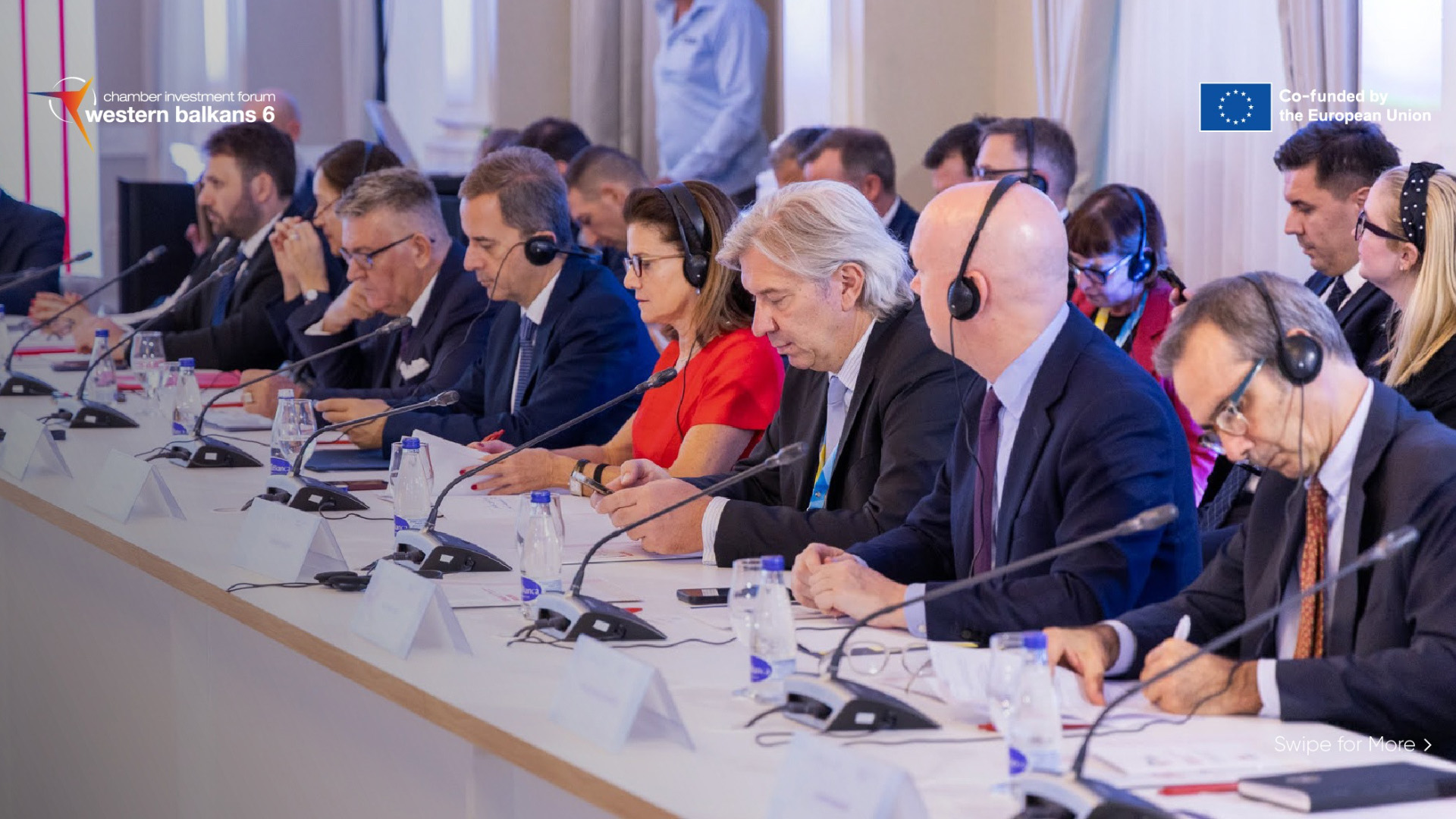
WB6 CIF Participates in Berlin Process Economy Ministers Meeting in Cetinje
Cetinje, Montenegro | 30 September 2026
The Western Balkans Six Chamber Investment Forum (WB6 CIF) contributed to the discussion on “Professional Mobility and the 90/180-Day Rule: Keeping EU–Western Balkans Freight Moving,” with David Piegazki, Secretary General of WB6 CIF, bringing the perspective of the regional business community to the discussion.
Professional international road transport depends on repeated cross-border mobility. Drivers from the Western Balkans operating in the Schengen area are subject to the general 90-day limit within any 180-day period, which can create operational challenges for drivers whose work requires frequent movement across EU Member States. The Entry/Exit System (EES) does not introduce this rule, but makes the recording of entries and exits more systematic.
David Piegazki, Secretary General of WB6 CIF, participated in the Economy Ministers Meeting held in Cetinje, Montenegro, within the framework of the Berlin Process.
The high-level meeting is part of a series of ministerial meetings leading up to the Western Balkans Leaders’ Summitand provided an opportunity to take stock of key commitments, achievements and ongoing priorities of the Berlin Process.
Addressing Professional Mobility Challenges
In his intervention, Mr Piegazki focused on the growing challenges related to professional mobility, particularly the implementation of the EU Entry/Exit System (EES) and the application of the 90/180-day rule to professional drivers from the Western Balkans.
Particular attention was given to professional drivers whose work requires frequent and repeated movement across Schengen borders. With systematic entry and exit recording under the EES and the 90/180-day limitation becoming increasingly relevant to their daily operations, coordinated and practical solutions are needed to avoid disruptions to freight flows and production networks.
A Shared EU–Western Balkans Challenge
The issue has implications well beyond the transport sector. Western Balkan companies are deeply integrated into European production and supply networks, providing components, intermediate goods and finished products to EU manufacturers in sectors including automotive, machinery and electrical equipment.
Reliable and predictable road freight is therefore essential for the resilience and competitiveness of both EU and Western Balkan supply chains.
This interdependence means that challenges affecting professional mobility can have wider implications for businesses and production networks on both sides of the EU–Western Balkans border.
A Targeted and Coordinated Approach
During the meeting, Mr Piegazki also referred to the Policy Brief produced by the Regional Center for Economic Analysis of the WB6 CIF, which examines the challenges related to professional mobility and the 90/180-day rule.
The Policy Brief advocates a targeted, coordinated and verifiable approach to professional mobility that would facilitate the movement of professional drivers and support EU–Western Balkans trade, while fully respecting the objectives of effective Schengen border management.
The Policy Brief also underlines the importance of reliable road freight for interconnected EU–Western Balkans supply chains and highlights the need for practical solutions that reflect the cross-border nature of international transport.
Bringing the Business Perspective into the Berlin Process
WB6 CIF will continue to bring the perspective of the regional business community into the Berlin Process, with a focus on removing practical barriers to trade, improving connectivity and strengthening the integration of the Western Balkans into the European Single Market.
Participation in high-level regional and European policy discussions provides an important platform for ensuring that the practical challenges faced by businesses are reflected in the ongoing dialogue on economic integration.

