GS1 Standards in the New Era of Global Trade: Training Held in Skopje
Skopje, North Macedonia | 12 November 2026
A company’s ability to identify, track and share accurate information about its products and shipments is becoming increasingly important in international trade. As supply chains evolve and regulatory requirements develop, international standards provide a common framework for companies operating across different markets.
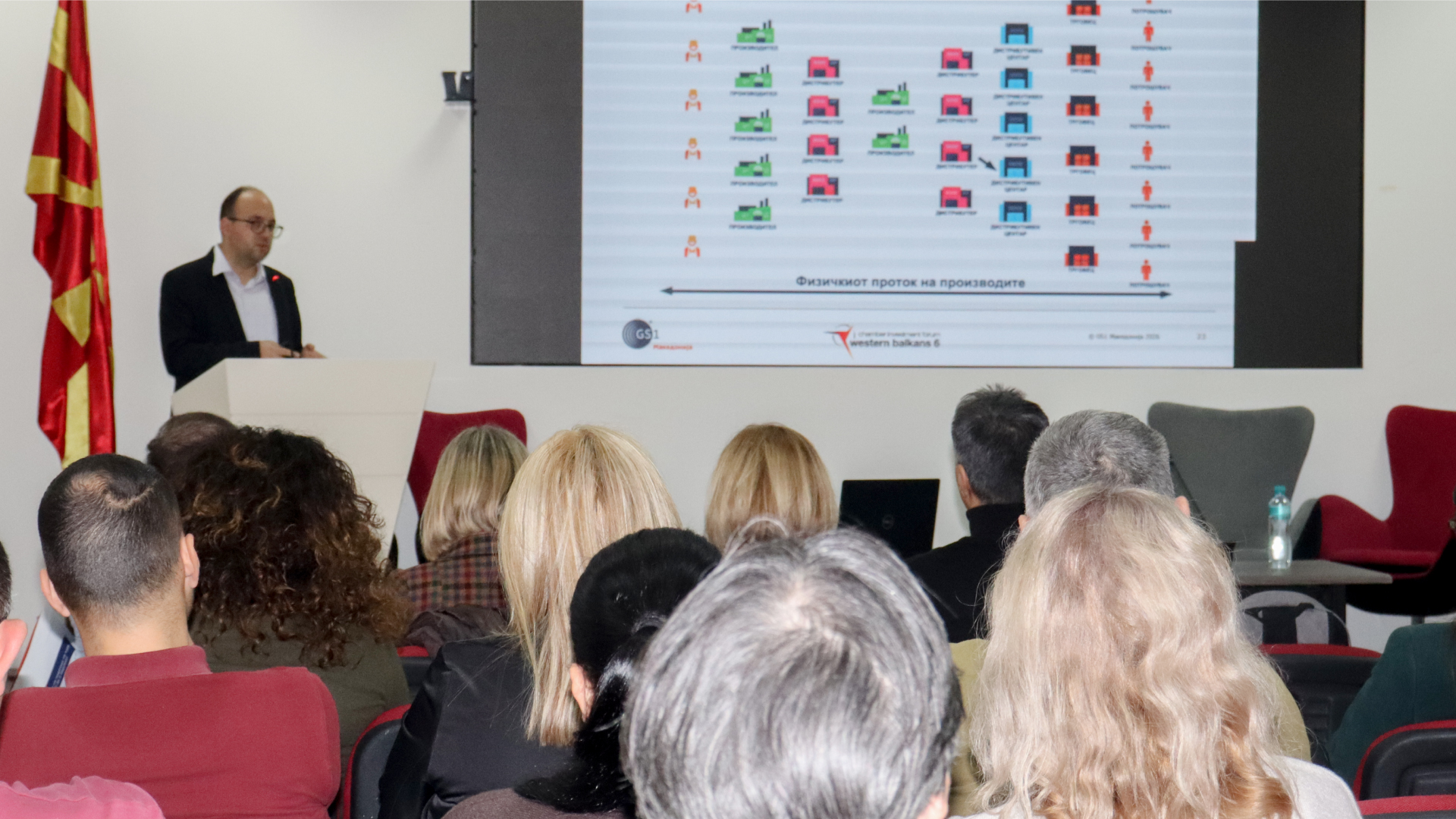
These topics were at the centre of the one-day training “GS1 Standards in the New Era of Global Trade”, held on 12 November 2026 in Skopje. The activity brought together representatives of 40 companies to explore how GS1 standards support product identification, logistics, traceability and the exchange of information across supply chains.
The training content was presented by GS1 Macedonia, the national organisation for GS1 standards.
Understanding Product and Shipment Identification
A key part of the training focused on the European Logistics Label and the role of standardised identification in logistics operations.
Participants explored how the Global Trade Item Number (GTIN), Serial Shipping Container Code (SSCC) and Global Location Number (GLN) are used to identify products, logistics units and locations.
The sessions also demonstrated how the European Logistics Label helps simplify the exchange of information between the sender, distributor and receiver, supporting the identification and handling of goods throughout the supply chain.
Traceability, 2D Barcodes and Digital Product Information
Another important topic was product traceability and the growing role of digital identification technologies.
The training addressed how traceability supports product recalls, consumer protection and efforts to combat counterfeiting. Participants also explored the ongoing transition from traditional one-dimensional (1D) barcodes towards two-dimensional (2D) barcodes and the opportunities this development brings for sharing product information.
The Digital Product Passport and the European Union’s new regulation were also discussed, highlighting the growing importance of accessible and reliable product information in the European market.
From International Standards to Practical Applications
Beyond the technical topics, the training included practical examples and software solutions demonstrating how GS1 standards can be applied in everyday company operations.
Through expert presentations and discussions, participants explored what products and shipments need in order to meet the requirements of international markets, particularly for companies involved in manufacturing, exports, distribution, trading and logistics.
The exchange provided an opportunity to better understand how standardised identification and digital solutions can support companies in their engagement with international supply chains.
Supporting Company Readiness for International Markets
Understanding and applying international standards is an important part of preparing companies to operate in increasingly interconnected markets. Access to relevant knowledge and practical tools can help companies respond to supply chain requirements, improve product traceability and strengthen their readiness for international trade.
The training in Skopje forms part of WB6 CIF’s broader efforts to support companies across the Western Balkans in strengthening their capacities and accessing opportunities within the Common Regional Market and beyond.
The activity was organised under the project “EU Support to the Western Balkans 6 Chamber Investment Forum for the Development of a Common Regional Market.”

